
CE Marking and air fryer safety: regulatory obligations and hidden risks
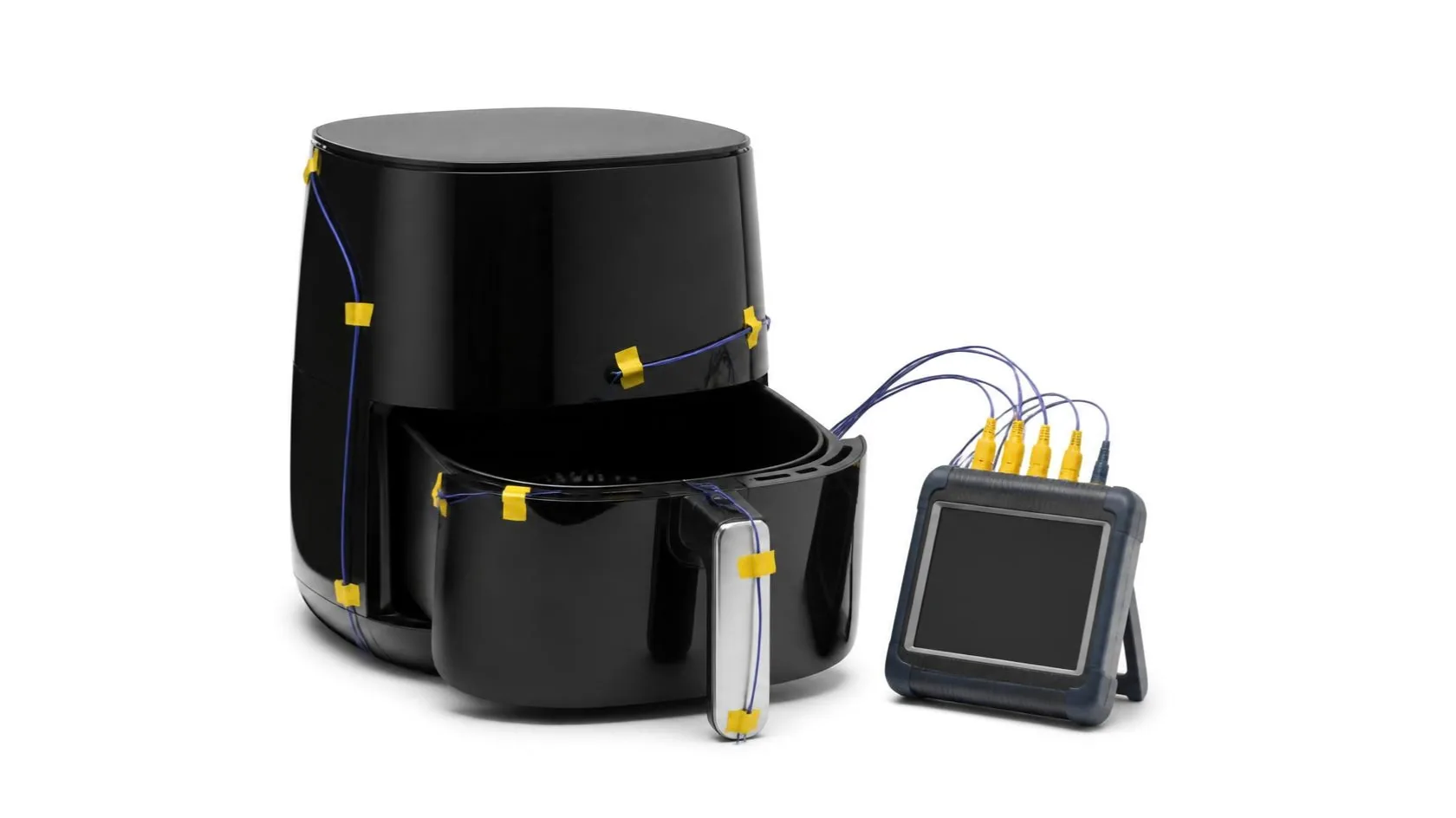
The growth of the air fryer market, fueled by price competition, can lead to critical safety situations, as demonstrated by several mass recalls, if this topic is not adequately addressed. The mandatory CE marking may not be sufficient as a guarantee of real product safety over time. Some of the causes behind massive product recalls are indeed consequences of prolonged use that ordinary standards do not always intercept. Economic operators placing the product on the market are legally responsible for issues arising from prolonged use as well.

Why CE marking alone might not be enough?
Understanding the gap between formal compliance, attested by CE marking, and real product safety over time has become crucial for mitigating legal and reputational risks.
Current market dynamics have indeed compromised the air fryer safety of many units, creating a situation where standard tests fail to predict all failure scenarios.
Price competition has pushed many manufacturers to use cheap and inadequate components, causing severe failures that standard CE marking tests do not always manage to prevent.
To cut production costs, some manufacturers choose risky components, such as lower quality plastics (e.g., Polypropylene – PP, instead of more resistant technopolymers like PBT or PPS) or undersized electrical parts, such as relays and microswitches.
These decisions, aimed at reducing costs, are directly correlated with an increase in critical failures, such as fires and melting plastics, documented by notifications from the EU rapid alert system (Safety Gate).
In this scenario, the responsibility and risk for distributors marketing products under their own brand increase drastically.
These market pressures have led to the emergence of specific and recurrent technical defects that every sector operator must know to further prevent them.
What are the 3 most dangerous design defects?
The analysis of major product recalls does not reveal isolated failures, but systemic failure modes, repeated across different models and brands. Knowing these technical vulnerabilities is the first step to building a robust and effective risk analysis.
Analyzing mass recalls, three recurring criticalities emerge:
- plastic deformation with fire risk
- welding of safety microswitches
- overheating of electrical connections.
1. Thermal deformation and fire
Intense heat generated during operation can deform internal plastics, especially if of low quality.
This deformation restricts or blocks ventilation channels, reducing the airflow needed to cool the heating element. This triggers a thermal runaway cycle: the internal temperature rises, the plastic deforms further, airflow is completely blocked, and overheating leads to fire.
2. Safety switch failure
The safety microswitch must cut power when the basket is removed.
However, the internal environment, saturated with oil vapors and humidity, can contaminate the switch’s electrical contacts. This contamination can cause melting and welding of the contacts, locking the switch in the “ON” position.
Consequently, the heating element remains active even when the basket is extracted, overheating plastic parts and creating a severe fire and electric shock risk.
3. Electrical connection overheating
Incorrectly fixed electrical connectors generate an abnormal increase in electrical resistance at the connection point.
When high currents pass through, this resistance generates intense, localized heat. The heat can melt cable insulation and trigger the ignition of surrounding plastic materials: a defect that has caused the recall of millions of units.
To overcome this criticality, the industry is progressively adopting more robust solutions like ceramic terminal blocks, spot welding, or spring connectors that compensate for thermal expansion.
The CE marking process relies on specific harmonized standards designed to prevent such risks.
What do safety standards EN 60335 verify?
The electrical safety of air fryers is mainly regulated by the Low Voltage Directive (LVD) 2014/35/EU.
Conformity to this directive is presumed through the application of harmonized technical standards, specifically the EN 60335 series. These standards form the technical basis for CE marking, defining the tests a product must pass to be considered safe.
Standards EN 60335-1 and EN 60335-2-9 are the basis for CE marking under the LVD directive. They define crucial tests on overheating, abnormal operation, and electrical safety, but their application on new products might not be enough.
Standards EN 60335-1 (general requirements) and EN 60335-2-9 (particular requirements for cooking appliances) focus on preventing major risks. Key tests include:
- Temperature limits: The standard sets maximum temperatures that external surfaces can reach during use to prevent burns. However, it allows higher temperatures provided the appropriate “hot surface” symbol is present on the product. This is a critical point: some manufacturers abuse this derogation to avoid the costs of more effective thermal insulation, effectively accelerating plastic aging and increasing burn risk.
- Abnormal operation: This is one of the most critical tests. It simulates real failure conditions, such as blocked air vents, fan failure, or thermostat short-circuit, to verify that the appliance does not become dangerous and that protection systems intervene correctly.
- Liquid spillage test: This test verifies that any liquids, such as hot grease that may spill during cooking, do not come into contact with live electrical parts, preventing short circuit and electric shock risks.
However, these tests are often performed on factory-new units and might not capture risks arising from material and component degradation after prolonged use.
GPSR: What changes for importers and distributors?
To bridge these types of gaps, the General Product Safety Regulation (GPSR, EU 2023/988) acts as a complementary “safety net” applicable even to CE-marked products for risk types not covered by specific standards.
To bridge these types of gaps, the General Product Safety Regulation requires a proactive approach.
The GPSR mandates drafting a risk analysis covering the product’s entire lifecycle: from design and production, to consumer use (intended use and reasonably foreseeable misuse), up to post-sales phases like maintenance, repair, and disposal.
In this perspective, risks resulting from prolonged use (example: internal accumulations of aerosolized grease which over time carbonize becoming solid fuel) or possible misuse (example: baking paper in contact with the internal heating element) must be taken into account within the “holistic” approach to safety required by the GPSR.
Note: The use of the term “air fryer” in this article is intended in a purely descriptive sense to indicate the product category.
Frequently Asked Questions (FAQ)
I am an importer, does the Chinese supplier’s CE certificate protect me?
No, the certificate is not enough. The importer is legally required to possess a complete technical file that also includes a specific risk analysis. They thus become directly and legally responsible for the product’s safety and cannot delegate this responsibility to the non-EU supplier.
What is the most underrated risk in air fryers?
Aerosolized grease accumulation. During cooking, this grease settles on the heating element and internal components, carbonizing and becoming a fuel. This fire risk, not covered by standard tests, can act as a true fire accelerant.
If I sell an air fryer under my own brand, who is legally responsible?
The brand owner. By affixing their own brand, they legally assume the status and all responsibilities of the “Manufacturer” according to EU legislation (LVD, GPSR). Responsibility cannot be delegated to the original manufacturer.
Do you need support for your product compliance?
Don’t let compliance become an obstacle.
I am available for an informal, no-obligation conversation.