
GPSR Risk Analysis Regulation (EU) 2023/988

Complete Guide for Economic Operators

The Regulation (EU) 2023/988 on general product safety (General Product Safety Regulation, GPSR) introduces a stringent requirement for manufacturers: to perform an internal risk analysis on every non-harmonized consumer product before placing it on the market.
Below, this obligation, its practical implications for economic operators (manufacturers, importers, and distributors), and the correct methods for conducting a GPSR risk analysis are examined.
The Regulatory Obligation for GPSR Risk Analysis
Article 9(2) of Regulation (EU) 2023/988:
Before placing their products on the market, manufacturers shall carry out an internal risk analysis and draw up technical documentation containing at least a general description of the product and its essential characteristics relevant for assessing its safety.
Where appropriate with regard to possible risks related to the product, the technical documentation referred to in the first subparagraph shall also contain, as applicable:
(a) an analysis of the possible risks related to the product and the solutions adopted to eliminate or mitigate such risks, including the outcome of any reports related to tests conducted by the manufacturer or by another party on their behalf;
[…]
Hazard vs Risk: The Fundamental Distinction
A correct GPSR risk analysis begins with a clear understanding of the difference between hazard and risk.
HAZARD
A potential source of harm, something that has the capacity to cause a negative effect (e.g., an injury, illness, material damage). It is an intrinsic property.
RISK
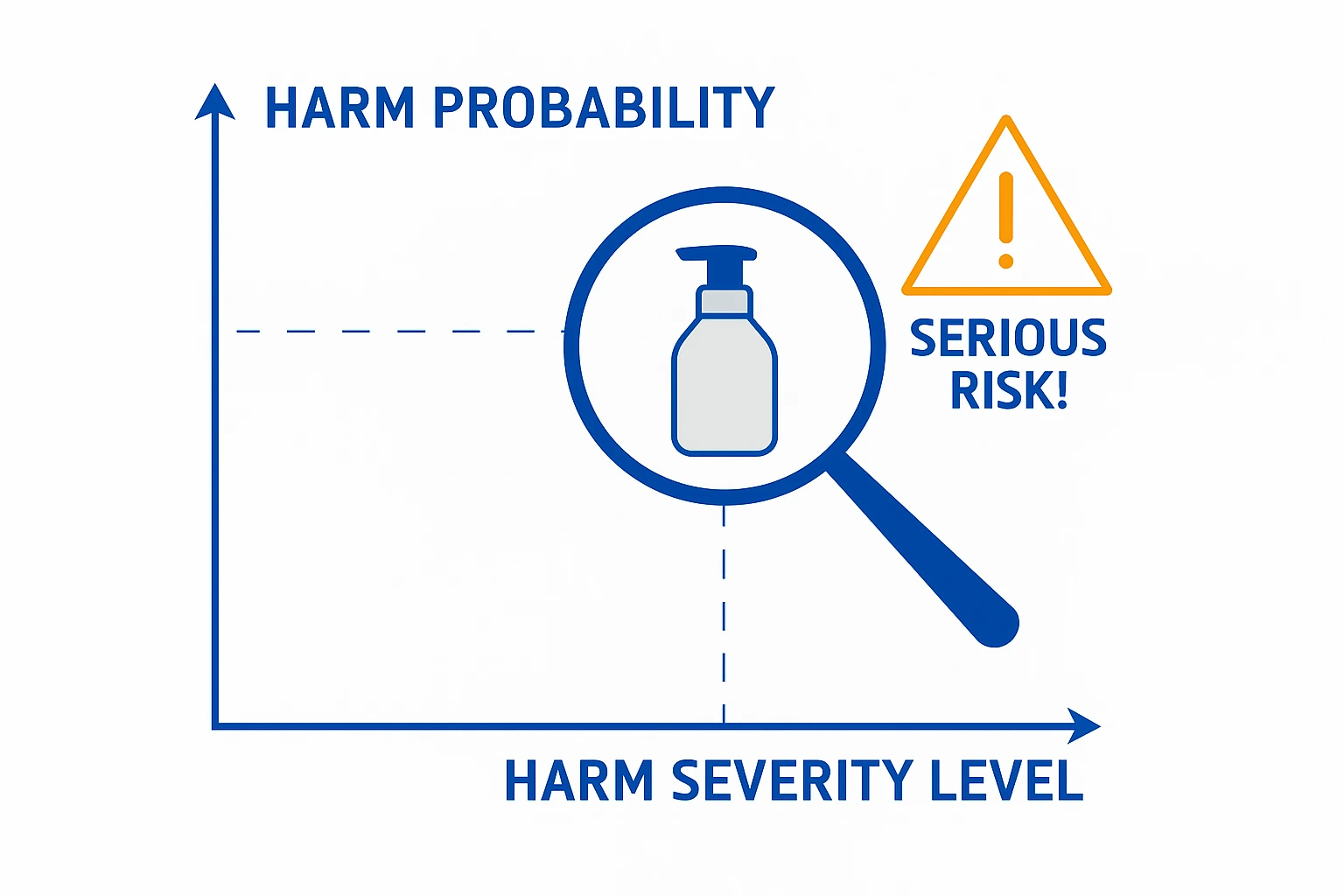
Probability that the hazard will actually cause harm, combined with the severity of that harm. Risk only exists if there is exposure to the hazard.
In summary: The hazard is the thing that can cause harm, the risk is the likelihood that it will cause harm and how much.
Example: Sharp Kitchen Knife
HAZARD
The sharp blade of the knife (it has the potential to cut).
LOW RISK
The knife is stored correctly in a block, handled carefully by an experienced adult. The probability of an accidental cut is low.
HIGH RISK
The same knife is left on the edge of a table where children are playing, unsupervised. The probability of a child getting cut is high.
Without hazard, there is no risk. However, a hazard does not always translate into a high risk: it depends on how it is managed and the probability of an incident occurring.
General Objective of Risk Management
Minimize the risks associated with the inherent hazards of products through GPSR risk analysis.
What does Article 9 entail for manufacturers?
Manufacturers must ALWAYS perform an internal risk analysis
Before placing EVERY non-harmonized product on the EU market, they must:
The result of this activity is the understanding of the “essential characteristics [of the product] relevant for assessing its safety”, which must be described in the technical documentation. These characteristics cannot be identified without first analyzing the risks.
The risk analysis activity may conclude at this point for simple products with low or obvious risks.
Example: Terracotta Flower Pot
 Conceptual image generated with AI for illustrative purposes.
Simple product, unglazed, small dimensions
Internal Risk Analysis:
Hazard Identification:
- Instability: Possibility of the pot tipping over
- Mechanical: Sharp edges or breaking into fragments
- Chemical: Release of substances from the material
Risk Assessment:
- Tipping over: Low (stable design)
- Edges/fragments: Low (well-finished)
- Chemical: Negligible (natural terracotta)
Safety Features:
- Design with a stable base
- Rounded upper edges
- Natural, untreated terracotta
Conclusion: A detailed written GPSR risk analysis as per Article 9(2), second subparagraph, point (a) does not seem “appropriate” in this case: the risks are minimal, easily identifiable, and mitigated by basic design features.
When is a detailed analysis necessary?
In the case of products with significant, complex, or less obvious risks, it is necessary for the technical documentation to contain “an analysis of the possible risks related to the product and the solutions adopted to eliminate or mitigate such risks”.
Specific document must include:
Principle of Proportionality
The inclusion of this detailed document in the technical documentation is required “where appropriate with regard to possible risks related to the product” based on a principle of proportionality to demonstrate the product’s safety and the manufacturer’s due diligence.
Example: Children’s Toy Storage Cabinet
 Conceptual image generated with AI for illustrative purposes.
Not classifiable as a toy itself, but intended for a child’s room
Hazard Identification (examples):
- Instability: tipping over if a child climbs on it
- Mechanical: sharp edges, entrapment, small parts
- Chemical: harmful substances from materials, paints, glues
Risk Assessment:
High probability of interaction…
- Tipping over: Significant (tendency to climb)
- Entrapment: Significant (curiosity and size)
- Chemical: Significant (sensitivity and prolonged exposure)
Technical Documentation Required per Article 9(2), second subparagraph, point (a):
Tipping Analysis
Design solutions and stability tests
Mechanical Analysis
Safe spaces, robust fixings, standard compliance
Chemical Analysis
Non-toxic materials, material tests
Conclusion: It is “appropriate” to conduct a comprehensive GPSR risk analysis as products intended for children require greater diligence. Authorities expect detailed documentation for this vulnerable user group.
Criteria for determining the required level of detail
The decision on how much detail to include in the written risk analysis depends on a responsible assessment by the manufacturer, considering:
Warning: For products with greater or less obvious risks, a scant and inadequately structured risk analysis would be difficult to defend and could be grounds for dispute or sanctions.
How to conduct an effective GPSR risk analysis
GPSR risk analysis requires a holistic approach, covering the entire product lifecycle: from design and production, to consumer use (intended use and reasonably foreseeable misuses), up to post-sale phases such as maintenance, repair, and disposal.
Aspects of the assessment according to Art. 6 of the Regulation and practical examples
Intrinsic characteristics
- Technical design
- Materials and components
- Structural robustness
- Stability
- Chemical properties
- Flammability
- Composition
- Packaging
- Instructions for use
Combined use
- Effect on other products
- Effect of other products and non-embedded items on the product
- Interaction with environment
- Indoor/outdoor use
- Humid environment
- Presence of children
- Climatic conditions
Presentation
- Labeling
- Packaging
- Product design
- Advertising
- Information provided
- Consumer communication
Target audience
- Intended users
- Vulnerable users
- Children
- Elderly
- People with disabilities
- Impact of gender differences
- At-risk categories
Misuse
- Use other than intended
- Appearance resembling food or appealing to children
- Reasonably foreseeable
- Common errors
- Unforeseen creative uses
- Ex: chair used as a ladder
Post-sale lifecycle
- Maintenance
- Lifespan
- Disposal
- Repair
- Safety over time
Risks from new technologies and cybersecurity
Obligation, where relevant to the nature of the product, to consider cybersecurity aspects and “smart” functionalities. If the product is digital or connected, one must evaluate:
- Hacking risks
- Loss of connection
- Malicious use
- Artificial intelligence
- Machine learning
- Behavioral evolution
- New emerging risks
Importance of professional competence
Implementing such a comprehensive and articulated risk analysis requires competent work and cannot be improvised nor, much less, can it be based solely on supplier self-declarations that… “everything is fine!”.
Determining and quantifying the level of risk
Methodological flexibility
Regulation (EU) 2023/988 (GPSR) does not impose the adoption of a specific methodology for conducting the risk analysis. Manufacturers have a certain flexibility in choosing the methodological approach they deem most appropriate for the nature of the product and its associated risks.
Primary objective
To prove that, following the application of adequate mitigation measures, any residual risk associated with the product is such that it does not compromise its conformity with the definition of a “safe product”, as established by Article 3(2) of the GPSR.
Definition of “safe product” – Art. 3(2) GPSR
Under Article 3(2) of the GPSR, a safe product is “any product which, under normal or reasonably foreseeable conditions of use, including the actual duration of use, does not present any risk or only the minimum risks compatible with the product’s use, considered acceptable and consistent with a high level of protection of the health and safety of consumers”.
Analytical and objective approach
To achieve the safety objective, it is essential that the level of risk is assessed and, where possible, quantified. Such quantification should preferably result from an analytical and objective process.
Advantages of the objective approach:
- Strengthens the validity of the assessment
- Demonstrates the manufacturer’s due diligence
- Ensures consumer safety
- Protects against challenges from authorities
Fundamental factors:
of the potential harm
of such harm
To which products does the GPSR risk analysis obligation apply?
Included products
Excluded products
Complementarity for harmonized products
For harmonized products (e.g., those bearing the CE marking), the GPSR applies only as a complement to existing requirements, for the aspects and risks not addressed by them. For those risks, the general safety requirement applies. The internal risk analysis obligation under Article 9 does not apply to harmonized products.
Examples of complementary risks:
- Risks from new technologies
- Impacts on consumers’ mental health
- Cybersecurity risks
- Aspects not covered by specific legislation
Obligations of other economic operators
Who is the “manufacturer” according to the GPSR?
‘manufacturer’ means any natural or legal person who manufactures a product or has a product designed or manufactured, and markets that product under that person’s name or trademark (Article 3(8) GPSR).
Risk analysis is a specific obligation for manufacturers.
Importers
They must ensure that the manufacturer has fulfilled the risk analysis obligations before placing the product on the EU market.
Distributors
Before making a product available on the market, they must verify that the manufacturer and, where applicable, the importer have complied with applicable obligations on identification data for the product and the operators and on instructions and safety information. Resellers are also distributors, unless they act as manufacturers or importers.
Liability of supply chain operators
Importers and distributors must verify that the operators preceding them in the supply chain have complied with the obligations that the Regulation requires them to check, otherwise they may incur penalties for breaching their own obligations. Damage caused by a defective product is governed by the civil rules on liability for defective products.
⚠️ WARNING: Each operator in the supply chain answers for its own obligations if a dangerous product is put on sale without the manufacturer having fulfilled its safety obligations!
The correct application of GPSR risk analysis requires attention, method, and specific expertise.
To support economic operators (manufacturers, importers, and distributors) in fulfilling these obligations and ensuring the safety and compliance of their products, I offer personalized consulting services.
Support for GPSR Risk Analysis
I am available for an initial, no-obligation exploratory meeting.
Risk Analysis
Complete and GPSR-compliant drafting
Technical Documentation
Preparation of required documentation
Regulatory Compliance
Verification and validation of compliance